Advertisement







Cheryl Hughes: Solution
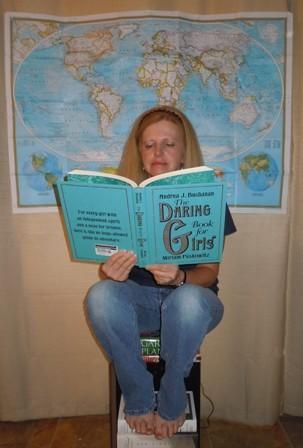
In his 1935 book, It Can’t Happen Here, Sinclair Lewis’ character, Doremus Jessup tells a group debating the virtues of one social group over another—Communists, Fascists, Constitutionalists, Monarchists—there is one solution to social ills and one solution alone. It is “the perfect, the inevitable, the only Solution, and that is: There is no Solution! There will never be a state of society anything like perfect!” (pgs. 111 and 112).
Those words, “There is no Solution,” ruffled my feathers and gave me over to somber thought as to their truth, as well as question the truth of the words that followed: “There will never be a time when there won’t be a large proportion of people who feel poor no matter how much they have, and envy their neighbors who know how to wear cheap clothes showily, and envy neighbors who can dance or make love or digest better.”
I don’t care much for phrases like, “there is no solution,” because I am a fix-it person, actually more like an attack-it then fix-it person. I find myself saying things like, “if they would, if he could, if she will,” a lot. I have this sense of not being able to be content if someone close to me is going through a problem. It’s as if I’m an emotional communist—I want everyone on a level playing field. And if they’re not there yet, then I want to hurry them along.
Yes, I know how crazy that sounds. I have no idea where I got this character flaw, but I can feel God starting to chip away at the attitude. He does things in a covert sort of way, seemingly insignificant situations that hit you later with the force of two-by-four to the face. One such incident happened to me two weeks ago on a busy street in Bowling Green.
I was in the left lane. A pickup was in front of me. There were cars behind me, as well as cars in the right lane beside me. It was a busy afternoon, but traffic was flowing moderately well until the pickup in front of me stopped and put on his right turn signal. The only street to the right at that point turned into an apartment complex. The cars on the right would not let the pickup into their lane. The pickup truck persisted, and traffic backed up behind me. I became frustrated.
“Look,” I said to the pickup, even though I knew the driver couldn’t hear me, “If you needed to go to that apartment building, you should have planned ahead. If you don’t need to get into that complex, you need to go on down the road and try again later to get into the right lane.”
He didn’t listen, so we sat there, him with his right blinker on, me continuing to offer a solution for his problem, that would fix my problem, as well, and the gaggle of cars lined up behind me. Finally a kind gentleman in the right lane allowed the pickup to go ahead of him. It was then that I saw the two-car accident in the left lane that put me in the same position in which the pickup had found himself moments before.
This is what I learned: Sometimes, it is not the car in front of you that has the problem. Sometimes, it is the car in front of the car in front of you. All of the solutions I offered the pickup truck were null and void. There were no solutions save one: Wait for a kind soul to offer you a spot. “Mercy triumphs over judgement,” James 2 v13 says. I’ve always been more of a “for every action, there is an equal and opposite reaction” sort of person. Predictable solutions give you some semblance of control, but in the end, it’s mostly an illusion. Sinclair Lewis will be proven right more times than not. There is no solution. You might as well sit back and wait for the kind gentleman in the right lane.
- Log in to post comments

Advertisements



Clicking on an ad will open the advertiser's web site or a larger view of the ad. Advertise with us!
Advertisements