Advertisement







House bill clarifying traceable communications law advances
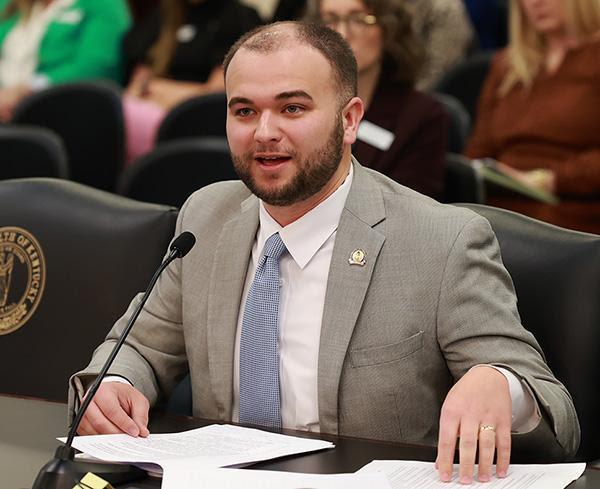
FRANKFORT, Ky. (March 4, 2026) — A bill seeking to clarify a law designed to provide oversight on communications between students and public school faculty and staff is on the move.
House Bill 67, sponsored by Rep. J.T. Payne, R-Henderson, received unanimous approval from the House Primary and Secondary Education Committee on Wednesday. Payne said the legislation builds on Senate Bill 181 from the 2025 legislative session.
“Senate Bill 181 is a very well-intentioned piece of legislation that maybe had some unintended consequences,” Payne said. “Our goal in this bill, House Bill 67, is to clean up that the best we can to still protect our students, but also not to make it more difficult for teachers to do their job and be the professionals that they are.”
SB 181 required public school districts to establish a traceable electronic communications system between students and teachers and other school authority figures to provide oversight and establish boundaries.
The current law does provide a few exceptions as to who is required to communicate with a student via traceable communications. A parent teaching at the same school as their child, for example, is exempted from exclusively using traceable communications with their own child under current law.
HB 67 would expand the list of individuals exempted from using traceable communications and provide other clarifications, Payne said.
Under the legislation, cousins would be added to the list of exempted family members as well as any adult who lives in the same household as the student.
A group text involving two or more school employees or qualified volunteers and one or more students for an academic, athletic or extracurricular purpose is also among the new exemptions listed in the legislation.
Payne said HB 67 would also better define a qualified school volunteer.
Additionally, Payne told the committee that teachers who may encounter students via other jobs outside the school system, like a youth pastor, delivery driver or a photographer, may disclose that job and be exempt from using a traceable communication system for those purposes under the bill.
In case of an emergency, HB 67 would allow a teacher to respond to a student outside of the traceable communications system.
“They can help that student and then disclose that communication afterward and be perfectly ok,” Payne said. “Then it also says that as part of a field trip or work-based learning experience, teachers can contact students.”
HB 67 would also further clarify which social media communications are exempt, Payne said.
“House Bill 67 clarifies and says no, if it’s a public post or public comment and not a private one then it is ok,” he said.
Rep. Timmy Truett, R-McKee, is an educator and a youth leader at his church. He asked if he would be able to contact his youth group about events at church without notifying his school.
Payne said yes, as long as he discloses the job.
“You say I’m a youth pastor at such and such church, then yes. That would allow you to have those communications,” he said.
Rep. Lisa Willner, D-Louisville, thanked Payne for the legislation. She asked Payne who he consulted with when drafting the bill.
Payne said he met with the Kentucky School Boards Association, Kentucky Association of School Administrators, Kentucky Department of Education, Kentucky League of Cities, Kentucky Farm Bureau and more while drafting HB 67.
HB 67 is now before the full House for consideration.

Advertisements



Clicking on an ad will open the advertiser's web site or a larger view of the ad. Advertise with us!
Advertisements