Advertisement







Legislators pass a series of major bills ahead of the veto recess
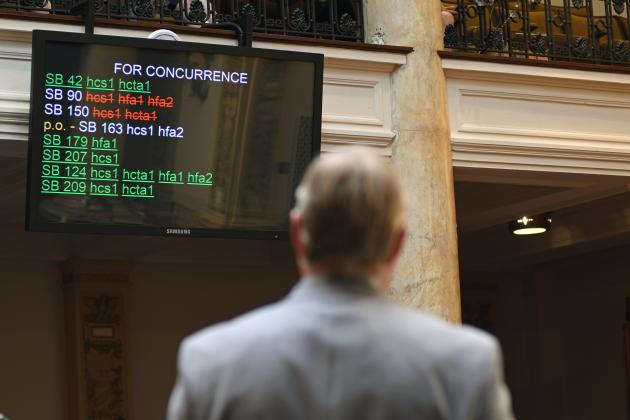
FRANKFORT – The Kentucky General Assembly gaveled out for a 10-day veto recess after passing a landmark state budget and a volley of other prominent bills this week on tax reform, charter schools, abortion, gambling, elections and changes to public assistance.
In all, lawmakers delivered 140 bills to the governor’s desk over a two-day marathon of voting and debate on the chamber floors. The action wrapped up close to midnight on Wednesday.
The governor now has until the end of the day on April 11 to sign the bills, let them become law without his signature or issue vetoes. Lawmakers will have an opportunity to override any vetoes when the General Assembly reconvenes on April 13-14 for the final two days of the session.
Here are some of the bills that received final passage before both chambers adjourned:
Budget: House Bill 1 would provide an historic two-year spending plan for the state executive branch with funding for employee raises, full-day kindergarten and increases to the state’s per pupil funding formula. It would also provide major investments in public pensions, state parks, clean drinking water projects and the state fairgrounds.
Abortion: House Bill 3 would ban abortions in Kentucky at 15 weeks of gestation and require minors to obtain consent from their parents before undergoing the procedure. The omnibus bill would also ban online sales of abortion-inducing drugs and regulate the disposal of fetal remains.
Tax reform: House Bill 8 seeks to gradually reduce and eliminate state taxes on personal income over several years while simultaneously expanding and diversifying the state’s overall tax base. Once state revenue exceeds certain thresholds, the measure would trigger reductions in the income tax rate of half a percentage point, starting with an initial drop in 2023.
Charter schools: House Bill 9 would establish a funding model for charter schools, building on legislation from 2017 that first allowed charters in Kentucky. It would also authorize two pilot charter school projects in Louisville and Northern Kentucky and change the appeals process if education officials deny an application for a new charter school.
Pari-mutuel wagering: House Bill 607 would tax every pari-mutuel wager at a standard 1.5% rate, including advance-deposit wagers and bets on simulcasts. It would also direct more money to the general fund, eliminate breakage, make the Kentucky Racing Commission responsible for self-funding, create a self-exclusion list for problem gamblers and eliminate the track admissions tax.
Public assistance: House Bill 7 aims to revamp public assistance benefits and combat fraud with new rules around benefit eligibility. It also seeks to increase accountability from the state Cabinet for Health and Family Services and encourage healthy choices for those receiving nutritional assistance.
School resource officers: House Bill 63 calls on local school districts to place a school resource officer in each school by Aug. 1 if they can afford the cost. It would also allow local school boards to establish a police department for the district.
Nursing shortages: Senate Bill 10 would make it easier for nurses from outside Kentucky to practice here, helping address major workforce shortages in the profession. It would also remove predetermined numbers for admission to nursing programs.
Porch pirates: Senate Bill 23 would crack down on people who steal packages off front porches, often referred to as porch pirates. The bill would make it a Class D felony to steal or destroy packages from common carriers and delivery services such as Amazon or FedEx.
Fentanyl: Known as Dalton’s Law, House Bill 215 would require those convicted of trafficking fentanyl, carfentanil or fentanyl derivatives to serve at least 85% of their criminal sentences, up from the current 50%. It would also make importing those drugs from another state or country a Class C felony and make offenders ineligible for a pretrial diversion.
School board meetings: House Bill 121 would require a public comment period of at least 15 minutes at local school board meetings, unless no one is signed up to speak. It would also require that any board rules and policies regarding conduct apply during the comment period.
Coroner training: Senate Bill 6, also known as Nathan’s Law, would require coroners to attend eight hours of training on the grieving process and procedures for death notifications. It would also establish certain procedures that coroners must follow in providing death notifications.
Crimes during emergencies: Senate Bill 179 would enhance penalties for crimes committed during a declared emergency related to a natural or man-made disaster. It would apply to assault, burglary, criminal trespass, criminal mischief, theft, receiving stolen property and robbery.
Election security: Senate Bill 216 seeks to enhance election security through multiple changes in law including a provision to prevent voting machines from being connected to the internet, among other provisions.
Swatting: House Bill 48 would make falsely reporting an incident that results in an emergency response – commonly called “swatting” – a Class D felony.
Due process: House Bill 290 calls on state colleges and universities to adopt a student code of conduct for non-academic disciplinary procedures and provide students with due process protections that are similar to those in criminal and civil courts.
Kentuckians can track the action through the Legislative Record webpage, which allows users to follow a bill’s progression through the chambers.
Citizens can also share their views on issues with lawmakers by calling the General Assembly’s toll-free message line at 1-800-372-7181.

Advertisements



Clicking on an ad will open the advertiser's web site or a larger view of the ad. Advertise with us!
Advertisements